A Stage for Every Season: How the Fox Theatre's Evolving Lineup Has Mirrored Detroit's Aspirations Through the Decades
Photo: Geo Swan from Toronto, Canada, CC0, via Wikimedia Commons
There is a particular kind of institutional memory that lives not in filing cabinets or library archives, but in the accumulated choices made night after night on a single stage. At the Fox Theatre, that memory stretches across nearly a century—encompassing jugglers and jazz orchestras, silent films and Hollywood talkies, rock spectacles and Tony Award-winning musicals. To read the programming history of this house is to read Detroit itself: its periods of breathtaking confidence, its seasons of hardship, and its ongoing, determined effort to reclaim its place among America's great cities.
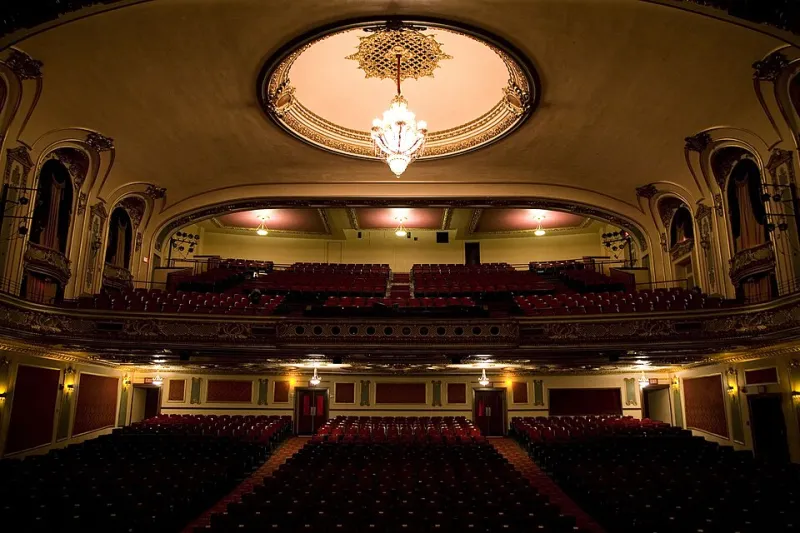
The Fox opened its doors in September 1928, and from its very first weeks it embodied a particular philosophy of entertainment that was both democratic and dazzling. William Fox, the studio magnate who commissioned the theatre, understood that the American moviegoing public wanted to feel elevated—not merely to watch a performance, but to inhabit, for a few hours, a world of genuine magnificence. The result was a 5,000-seat Siamese-Byzantine palace whose ornate interior communicated, without a single spoken word, that something extraordinary was about to occur.
The Vaudeville Years: Entertainment as Civic Confidence
In its earliest incarnation, the Fox offered what was then the dominant popular entertainment form in America: vaudeville. The bills were deliberately varied, mixing comedians, acrobats, musical acts, and novelty performers in rapid succession. This format was not accidental. Vaudeville thrived precisely because it asked nothing complicated of its audience. A factory worker finishing a double shift at one of the city's booming automotive plants could settle into a velvet seat and follow the evening's pleasures without difficulty.
Detroit in the late 1920s was a city intoxicated by its own productivity. The automobile industry had transformed it from a modest Great Lakes port into one of the wealthiest manufacturing centers on earth. The Fox's vaudeville programming reflected that prosperity—it was entertainment that celebrated energy, spectacle, and the sheer pleasure of abundance. Audiences did not arrive seeking catharsis or intellectual provocation. They arrived to celebrate.
The transition to synchronized sound in the early 1930s altered the Fox's identity significantly. As Hollywood's talkies supplanted live performance as the primary draw, the theatre repositioned itself as a premier picture palace, supplementing films with live stage acts that gradually shrank in prominence. The shift mirrored a broader national trend, but in Detroit it carried particular weight: the city's working-class audiences, many of them newly arrived migrants from the American South and from Europe, found in Hollywood cinema a shared cultural language that transcended neighborhood and background.
The Postwar Period: Broadway Ambitions and the Dream of Sophistication
The decades following World War II introduced a new aspiration to the Fox's programming calendar. As Detroit's middle class expanded dramatically—fueled by union wages, suburban development, and the seemingly inexhaustible demand for American automobiles—audiences began seeking entertainment that reflected their elevated social standing. Touring productions of Broadway musicals arrived with increasing frequency, bringing with them the prestige associated with New York's theatrical establishment.
This was not mere entertainment. It was a statement of arrival. To attend a touring production of a celebrated Broadway show at the Fox was to participate in a cultural ritual that connected Detroiters to the wider American mainstream. Programming directors of that era understood intuitively that their audiences were not simply purchasing tickets; they were purchasing a sense of belonging to something larger than their individual circumstances.
The Fox's booking patterns during this period tracked closely with the city's economic fortunes. Prosperous seasons brought ambitious productions with large casts and elaborate sets. Leaner years saw the theatre pivot toward more modestly scaled offerings, or toward popular music concerts that could fill seats with less financial risk. The stage functioned, in this sense, as a kind of cultural barometer—registering shifts in civic confidence with remarkable sensitivity.
Decline and Darkness: When the Stage Went Silent
By the 1970s, the forces reshaping Detroit—deindustrialization, population loss, fiscal crisis—had reached the Fox's box office. Attendance declined precipitously. The theatre that had once welcomed millions of visitors each year found itself struggling to remain viable. For a period in the early 1980s, it closed entirely, its magnificent interior threatened by neglect and the possibility of demolition.
The programming void of those years was itself a form of expression. A city whose industrial base had collapsed, whose population had contracted by hundreds of thousands, whose downtown corridors had emptied, no longer had the civic infrastructure to sustain a performance palace of the Fox's scale. The darkened stage reflected a community wrestling with losses that felt, to many, irreversible.
Yet the story did not end there. The restoration of the Fox, completed in 1988 under the stewardship of Mike and Marian Ilitch, represented one of the most consequential acts of civic investment in Detroit's modern history. The decision to restore rather than demolish, to reopen rather than repurpose, was itself a programming choice—a declaration that Detroit's appetite for culture, for beauty, for shared public experience, had not been extinguished.
The Contemporary Stage: Broadway, Diversity, and the Revitalization Era
The Fox's current programming reflects a city in active transformation. Today's lineup balances the reliable prestige of Broadway's longest-running productions with a deliberate effort to engage Detroit's extraordinary cultural diversity. Touring companies of landmark musicals arrive alongside performances that speak directly to African American, Latino, and immigrant communities whose contributions have shaped the city's character for generations.
This is not tokenism; it is strategy rooted in genuine understanding. Detroit's revitalization has been driven in significant part by communities that were present during the city's most difficult decades and who remained committed to its renewal. A programming philosophy that acknowledges their presence—and their purchasing power—is both ethically sound and commercially astute.
Conversations with those who have shaped the Fox's contemporary booking philosophy reveal a consistent theme: the goal is not merely to import cultural product from elsewhere, but to make the Fox a genuine reflection of what Detroit is becoming. That means welcoming touring productions that have already proven themselves on Broadway while also remaining alert to performances that resonate with the specific textures of this particular city.
What the Stage Reveals
The Fox Theatre's programming history is ultimately a record of negotiation—between aspiration and circumstance, between the universal and the local, between what a city wishes to be and what it actually is at any given moment. Vaudeville served a city drunk on industrial confidence. Hollywood pictures served a city building a shared identity across lines of origin and background. Broadway tours served a city asserting its sophistication. And today's eclectic, inclusive programming serves a city engaged in the complex, hopeful work of reinvention.
None of these transitions were accidental. Each represented a reading of the audience—of what Detroiters needed from their most magnificent shared space at a particular point in their collective history. That the Fox has survived long enough to make so many such readings is itself a testament to the enduring human conviction that a great stage, in a great city, is never merely a place of entertainment. It is a place where a community comes to understand itself.
The curtain continues to rise. And Detroit continues to dream.