Beyond the Spotlight: The Hidden Spaces That Make Every Visit to the Fox Theatre Unforgettable
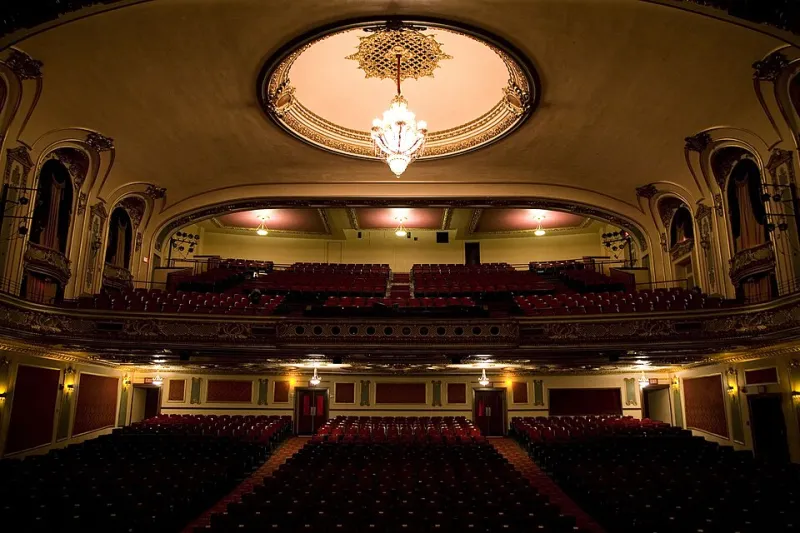
Photo: Unknown authorUnknown author or not provided, Public domain, via Wikimedia Commons
Most visitors arrive at the Fox Theatre with their eyes fixed firmly on one destination: the stage. Yet long before the house lights dim and the curtain rises, something quieter and perhaps equally meaningful is already unfolding throughout the building. In its corridors, beneath its ornate archways, and along the curved rails of its upper balconies, strangers become neighbors, memories are exchanged, and the simple act of being present in a singular space becomes its own form of performance.
The Fox Theatre, which first opened its doors in 1928, was designed by architect C. Howard Crane with a philosophy that extended well beyond acoustics and sightlines. Crane understood that a great theatre does not merely house an audience—it shapes one. The result is a building of extraordinary spatial variety, where no two vantage points feel quite alike, and where the experience of attending an event is subtly but meaningfully different depending on where you stand, sit, or linger.
A Lobby That Commands Attention Before the Show Begins
For many patrons, the grand lobby is the first revelation. Its soaring ceilings, adorned with intricate plasterwork and warm amber lighting, create an atmosphere that feels simultaneously celebratory and intimate. The space is large enough to accommodate hundreds of guests, yet the architectural detailing draws the eye inward, making individuals feel anchored rather than lost.
Regular attendees often remark that arriving early has become a ritual in itself. "I used to rush in right before the show started," admits one longtime patron who has attended performances at the Fox for more than two decades. "Now I come forty-five minutes early just to stand in the lobby and watch people. There's something about the way this building makes everyone stand a little taller."
That effect is not accidental. The lobby's proportions encourage unhurried movement and natural congregation. Guests drift toward the ornamental columns, pause beneath the chandeliers, and inevitably fall into conversation with strangers who share their anticipation. The space functions, in its own way, as a social overture—a prelude to the shared experience awaiting inside.
The Mezzanine: Where Intimacy Finds a Home
Climb one level, and the character of the building shifts entirely. The mezzanine level offers a series of alcoves, viewing corridors, and lounge areas that feel almost conspiratorial in their coziness. Here, the grandeur of the lobby gives way to something more personal. Couples find quiet corners to collect their thoughts before a performance. Friends lean against the carved railings and look out over the lobby below, observing the crowd with the quiet satisfaction of those who have discovered a privileged vantage point.
Ushers who have worked the mezzanine for many years speak of it with particular affection. "People come up here and they slow down," one usher notes. "Downstairs it's exciting, energetic—everyone's moving. Up here, they exhale. I've seen people have the most beautiful conversations in these little alcoves. You'd never expect it, but this level has a way of bringing people together."
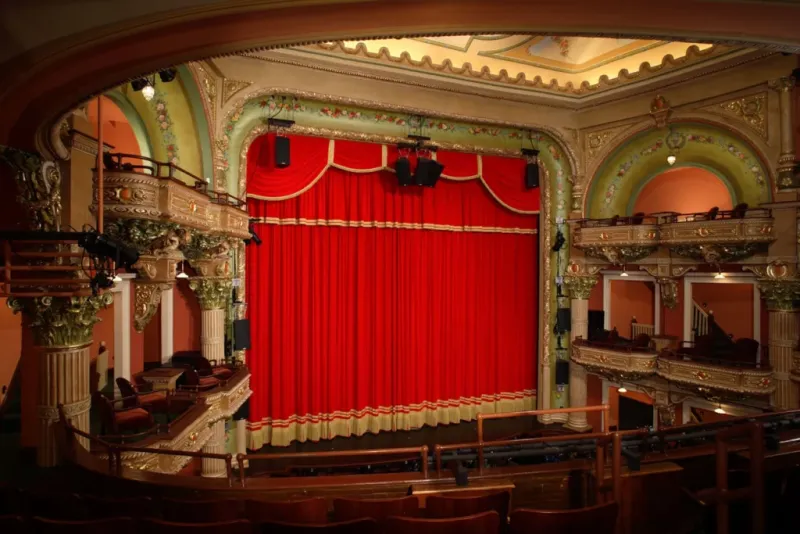
The mezzanine is also a space that rewards curiosity. Architectural details that might be overlooked at ground level become visible here: the precise geometry of the plasterwork, the depth of color in the ceiling murals, the way light travels differently through the upper registers of the building. For those willing to look, it offers an education in the craft of theatrical design.
Backstage: A World Parallel to the Performance
For a select few—those fortunate enough to participate in special tours or backstage programming—the Fox Theatre reveals yet another dimension entirely. Behind the velvet curtains and beyond the stage door lies a working world of remarkable complexity: dressing rooms layered with the history of countless performers, narrow corridors that echo with the footsteps of stagehands moving with practiced efficiency, and the controlled energy of a production in motion.
Performers who have appeared at the Fox frequently describe the backstage environment as unexpectedly affecting. "There's a weight to the space," one touring production's lead actor reflected after a recent engagement. "You're aware that extraordinary people have stood in these exact spots, preparing themselves in exactly the way you're preparing now. It's humbling. It connects you to something larger than your own performance."
That sense of continuity—of being part of a living lineage—is something the Fox Theatre's staff works deliberately to preserve and communicate. Backstage tours offered through the theatre's programming calendar allow audiences to cross the threshold from observer to participant, encountering the building not as a backdrop but as a character in its own right.
Serendipity by Design
What emerges from conversations with patrons, staff, and performers is a consistent theme: the Fox Theatre's spatial diversity is not merely an architectural curiosity but a genuine generator of human connection. The building creates conditions for serendipity. A chance remark exchanged while admiring a ceiling medallion becomes a conversation that lasts through intermission. A couple who meets in the lobby queue discovers they are seated in adjacent rows. A first-time visitor, exploring the upper balcony before the show, encounters a retired stagehand who shares memories of performances from forty years prior.
These moments are not programmed. They arise organically from the way the building moves people through space—encouraging pause, promoting proximity, and rewarding those who resist the impulse to look only forward.
"The Fox doesn't let you be passive," observes one regular patron who has attended well over a hundred performances at the venue. "Even if you tried to just walk in and sit down, the building would stop you. There's always something to notice, someone to talk to. It's alive in a way that most places aren't."
The Architecture of Memory
Ultimately, what the Fox Theatre's varied spaces accomplish is the creation of memory—not only of the performances that unfold on its stage, but of the full texture of an evening spent within its walls. Patrons recall not just the music they heard or the story they witnessed, but the warmth of the lobby light, the view from the mezzanine rail, the sound of conversation rising toward an ornamented ceiling.
This is the Fox Theatre's most enduring gift to Detroit: a space so thoughtfully conceived that the act of simply being present within it becomes part of the cultural experience. The stage may be where the story is told, but the building ensures that the audience, too, is always part of the narrative.
For those who have yet to explore the Fox Theatre beyond their assigned seat, the invitation is open. Arrive early. Wander deliberately. Let the building surprise you. Detroit's most beloved cultural landmark has far more to offer than any single performance—and it has been waiting, patiently and beautifully, to show you.