First Steps on a Grand Stage: How the Fox Theatre Shapes Detroit's Rising Artists
Photo: Melnikov v n, CC0, via Wikimedia Commons
There is a particular moment that nearly every young performer describes in the same way. Standing in the wings of the Fox Theatre — heart racing, the weight of 5,000 seats pressing silently against them — they feel something shift. The grandeur of the space does not intimidate so much as it clarifies. Suddenly, the work matters in a way it never quite did before.
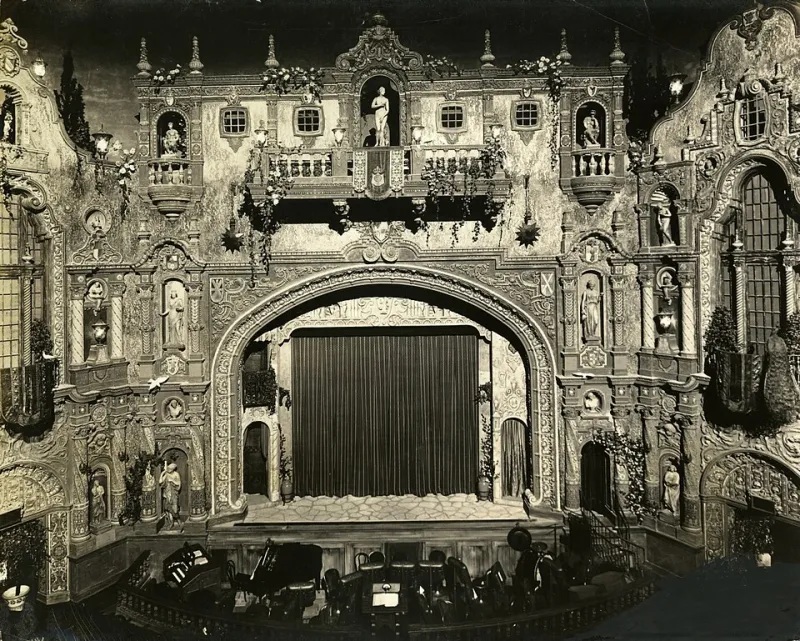
For more than nine decades, the Fox Theatre has occupied a singular position in Detroit's cultural life. Its Siamese-Byzantine splendor, its storied history, its reputation as one of the finest surviving movie palaces in the United States — these qualities draw world-class productions and celebrated performers from across the country. Yet woven quietly into that legacy is another story, one less frequently told: the story of the emerging artists for whom the Fox has functioned as an unofficial finishing school.
The Weight of the Room
Anyone who has performed at the Fox Theatre will tell you that the building itself teaches. The architecture demands a certain quality of presence. The soaring auditorium, adorned with hand-carved ornamentation and bathed in the warm glow of its celebrated chandeliers, offers no place to hide. A performer must expand to fill it — not merely in volume, but in intention.
For young artists arriving in supporting roles or as understudies with touring productions, this reality becomes their most demanding instructor. They watch how seasoned performers move through the space, how they calibrate their energy to reach the balcony without sacrificing the intimacy required for the front rows. They study the acoustics, learning that the Fox rewards precision and punishes carelessness.
This education is not written into any contract or program note. It is absorbed through proximity, through repetition, through the quiet discipline of showing up night after night in one of America's most storied theatrical environments.
Detroit's Own on a National Platform
The Fox Theatre has long maintained a commitment to featuring local and regional talent alongside national touring companies. For Detroit-based musicians, dancers, and vocalists, an invitation to perform at the Fox carries a weight that extends well beyond a single evening's engagement.
Local jazz ensembles that have opened for major acts describe the experience as a kind of professional baptism. The exposure to a full-capacity audience — one that arrives with elevated expectations and a deep familiarity with excellence — compresses years of ordinary development into a single concentrated event. Performers are required, almost by the nature of the occasion, to become more than they were when they walked in.
This dynamic is not accidental. The Fox Theatre's programming philosophy has consistently recognized that a cultural institution serves its community most fully when it creates genuine pathways for local talent, rather than simply importing excellence from elsewhere. The stage that has welcomed some of the most celebrated names in American entertainment has also, deliberately and consistently, made room for the artists who call Detroit home.
Understudies and the Art of Readiness
Perhaps no figure in the theatrical ecosystem embodies the apprenticeship model more completely than the understudy. These performers occupy a demanding and often underappreciated position: they must maintain peak readiness for a role they may never be called upon to play, all while supporting the production in whatever capacity the moment requires.
For understudies working productions at the Fox, the theatre's environment intensifies this already rigorous discipline. They attend every rehearsal with a quality of attention that borders on the forensic. They study not only lines and blocking, but the particular way a performance breathes within this specific space — how the sightlines from the mezzanine affect staging choices, how the acoustic profile of the house shapes vocal delivery.
When the call comes — and for many understudies at the Fox, it eventually does — the preparation meets the moment in a way that can feel almost inevitable. The theatre has been rehearsing them all along.
Mentorship Beyond the Formal
The Fox Theatre's role as a mentoring environment operates largely through informal channels. A touring musical director pausing to offer a word of technical guidance to a local musician. A choreographer sharing insights about adapting movement for a proscenium of this particular scale. A veteran stage manager explaining the logic behind a callsheet to a young production assistant who will carry that knowledge into a career.
These exchanges are not catalogued or celebrated. They happen in hallways and dressing rooms, during load-ins and tech rehearsals, in the brief windows between the visible work of putting on a show. Yet their cumulative effect on Detroit's artistic community has been profound. Many of the city's most accomplished working performers can trace a meaningful portion of their professional formation to time spent within the Fox's walls.
The theatre's staff, too, contributes to this culture of transmission. Technicians with decades of experience at the Fox bring an institutional knowledge that younger crew members absorb through the daily practice of collaboration. The building's complexity — its systems, its history, its particular demands — creates a learning environment that no classroom could replicate.
A Living Classroom for Detroit's Future
What makes the Fox Theatre's role as a nurturing ground for emerging artists particularly significant is the context in which it operates. Detroit has always been a city that produces remarkable creative talent — in music, in visual art, in performance of every kind. The Fox Theatre sits at the center of that tradition, not merely as a showcase for what Detroit has already achieved, but as an active participant in shaping what comes next.
The young artist who finds her voice in a supporting role at the Fox carries that experience into every subsequent performance of her career. The musician who navigates the particular acoustics of the auditorium for the first time emerges with a refined understanding of his own instrument. The understudy who steps into the light when the moment demands it discovers a version of himself that the ordinary circuits of professional development might have taken years to reveal.
This is the Fox Theatre's quieter legacy — not the celebrated names on the marquee, but the countless careers that were quietly, indelibly shaped by what it feels like to stand on that stage, in that room, before an audience that has come to expect something extraordinary.
Detroit's story, as it has always been, is one of transformation through adversity and ambition. The Fox Theatre understands this. It has been telling that story, in its own way, for a very long time.