Where You Sit Is Where You Feel: The Psychology of Perspective at the Fox Theatre
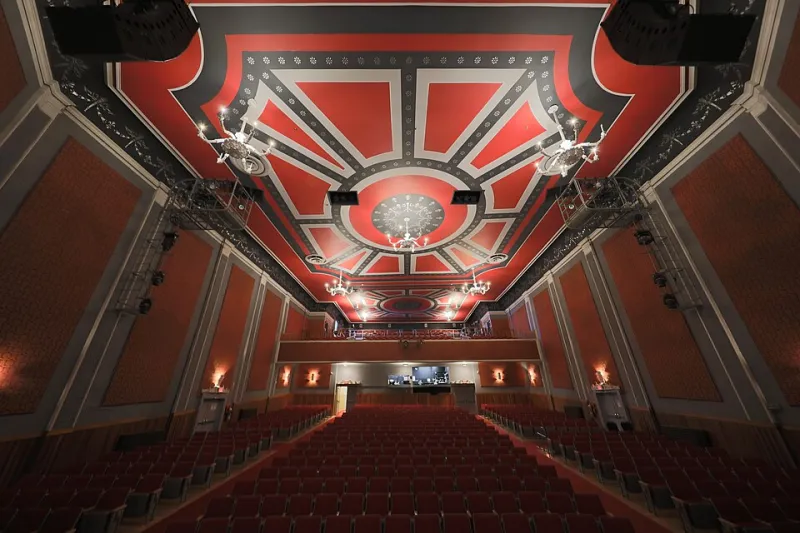
Photo: Ken Heaton, CC BY-SA 4.0, via Wikimedia Commons
There is a moment, familiar to anyone who has attended a performance at the Fox Theatre, when the house lights dim and the air changes. The gilded ceiling seems to draw closer. The murmur of the crowd dissolves. And then, depending on precisely where you are seated, something remarkable and entirely personal begins to unfold.
Two patrons attending the same production on the same evening may leave with profoundly different memories. One might describe the raw electricity of a performer's eyes, the tremor in a vocalist's jaw, the almost unbearable closeness of a dramatic monologue. The other might recall the sweeping geometry of an ensemble scene, the choreography resolving itself into something almost architectural from above, the full orchestral sound arriving as a single, unified wave. Neither experience is superior. But they are, in a meaningful sense, different performances.
This is the Fox Theatre's front-row effect—and it extends well beyond the first row.
The Orchestra Section: Immersion as an Art Form
The orchestra level of the Fox Theatre places patrons at the same elevation as the stage, creating a relationship with performers that is fundamentally horizontal. There is no remove here. When a lead performer crosses downstage, they are, at certain moments, close enough that the audience can perceive the fine details of costume craftsmanship, the physical effort behind a sustained note, the micro-expressions that no camera could adequately capture.
Dr. Susan Farwell, a cognitive psychologist who studies audience engagement at live performance venues, describes this phenomenon in terms of what she calls "perceptual intimacy." "When we are physically proximate to another person who is experiencing heightened emotion—even a performer enacting that emotion—our mirror neuron systems respond," she explains. "The closer we are, the more directly the performance enters us. It bypasses our analytical processing."
For patrons who prefer the visceral and the immediate, the orchestra section delivers an experience that is less about watching a story and more about inhabiting it. The trade-off, as any experienced theatregoer will acknowledge, is perspective. Large-scale production design, elaborate stage pictures involving the full cast, and choreographic patterns that require distance to resolve into legible shapes can feel fragmented from the lower orchestra. You gain proximity; you surrender panorama.
The Mezzanine: Elevation and Emotional Architecture
Rise one level, and the Fox Theatre reveals itself differently. The mezzanine offers what set designers and directors sometimes refer to as the "intended view"—the vantage point from which the full compositional logic of a production becomes visible. Sight lines open. The stage picture that a director has spent months constructing finally assembles itself into coherence.
Long-time Fox Theatre patron Marlene Hutchins, who has attended performances here for more than two decades, describes the mezzanine as her preferred location for large-scale musicals. "You understand the whole story from up there," she says. "You see where everyone is. You see the patterns. When the company comes together for a big number, it's like watching something click into place."
The acoustic experience also shifts. Sound engineers and venue acousticians note that the mezzanine level at the Fox Theatre benefits from the way sound radiates outward and upward from the stage, allowing certain frequencies—particularly the mid-range vocal tones that carry emotional weight in theatrical performance—to arrive with exceptional clarity. The Fox's original 1928 acoustic design, conceived for an era before electronic amplification, remains one of the building's most quietly extraordinary achievements, and it rewards those seated at elevation with a richness that is difficult to replicate elsewhere in the house.
Balcony Views: Distance as a Different Kind of Closeness
The upper balcony is, for some patrons, the most misunderstood section of the Fox Theatre. Distance from the stage is real, and it would be dishonest to suggest otherwise. But what the balcony sacrifices in physical proximity, it compensates for in a different dimension of experience entirely.
From the upper levels, the Fox Theatre's interior reveals itself as the work of architectural theater it was always meant to be. The Indo-Persian ornamentation of the ceiling, the cascading grandeur of the proscenium arch, the warm amber glow of a thousand points of light—all of it becomes part of the performance. For certain patrons, particularly those attending the Fox Theatre for the first time, this perspective offers something irreplaceable: the full understanding of what it means to be inside this building.
Fox Theatre operations director James Calloway notes that the balcony also holds a particular appeal for patrons with extensive theatrical experience. "People who have seen a production multiple times often want the balcony," he says. "They've already had the close-up experience. Now they want to see the whole canvas."
What the Designers Intended
The Fox Theatre was designed by architect C. Howard Crane, who understood that a theatre is not merely a container for performance but a machine for producing emotion. Every element of the seating arrangement—the rake of each section, the curvature of the balcony rail, the precise angle at which each row meets the stage—was calculated with the audience's psychological experience in mind.
Restoration architects who worked on the Fox Theatre's celebrated 1988 rehabilitation have spoken about the degree to which Crane's original sightline calculations were preserved and honored during the renovation process. The goal was never simply to restore a beautiful building but to restore a functional instrument—one designed to deliver specific emotional frequencies to specific locations in the house.
This is why no seat at the Fox Theatre can be dismissed as merely adequate. Each position in the auditorium represents a deliberate choice made by designers who understood the relationship between space, distance, and human feeling.
Finding Your Ideal Vantage Point
For patrons approaching a Fox Theatre booking with intention, a few practical considerations may guide the decision. Those attending an intimate dramatic production—a play driven by character and dialogue—may find the lower orchestra or front mezzanine most rewarding, where the performers' physical presence carries maximum weight. Those attending a large-scale musical with elaborate choreography and scenic design may prefer the center mezzanine, where the full stage picture resolves most clearly. Those seeking the complete Fox Theatre experience—building, performance, and atmosphere unified into a single event—may find the upper balcony offers something no other section can provide.
And for those who have never attended a performance here at all? The honest answer is that the first visit almost does not matter where you sit. The Fox Theatre has a way of overwhelming first-time visitors regardless of perspective. The building itself performs.
What matters, in the end, is that you return—and that next time, you sit somewhere different. Because where you sit is where you feel, and the Fox Theatre has more feelings to offer than any single evening can contain.