Secrets in the Plaster: The Architectural Revelations That Redefined the Fox Theatre's Restoration
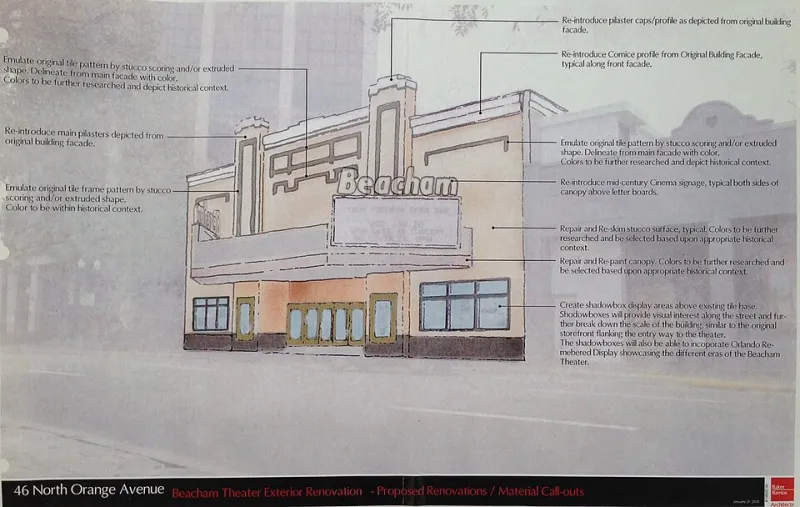
Photo: Photographic reproduction of City of Orlando Historic Preservation Board scan of original art by Baker Barrios, architects for The Beacham Theatre. *Baker Barrios denies ownership or knowledge of work., Public domain, via Wikimedia Commons
There is a particular kind of silence that falls over a restoration site when someone discovers something that was never supposed to be lost. It is not the silence of emptiness, but of recognition — the moment when the present reaches back and touches the past without flinching. Inside the Fox Theatre, that silence arrived more than once during the painstaking work of returning Detroit's most celebrated performance venue to its original brilliance.
What the restoration teams encountered beneath layers of paint, behind false partitions, and under decades of well-intentioned renovation was nothing short of extraordinary: a record of ambition, artistry, and civic pride that 1920s Detroit had embedded into every square foot of its grandest theatrical house.
The Blueprint Detectives
Before a single chisel was raised or a scaffold erected, the restoration required something more fundamental than construction expertise — it required scholarship. Architects and preservation specialists spent months combing through original blueprints held in archival collections, cross-referencing drawings attributed to the firm of C. Howard Crane, whose design vision for the Fox remains one of the most elaborate expressions of the "atmospheric theatre" movement in American architectural history.
Those blueprints, fragile with age but precise in their intentions, became the authoritative guide against which every discovered detail was measured. When a section of plasterwork was found beneath a mid-century paint application, restorers could consult Crane's original specifications to determine whether the pattern was authentic or a later approximation. The difference between the two, in preservation terms, is the difference between history and imitation.
"You develop an instinct for what belongs," one restoration architect noted during consultations with the project team. "The original craftsmen had a logic to their ornamentation. Once you understand that logic, the anachronisms become obvious — and the authentic details become luminous."
The Murals That Time Concealed
Perhaps no discovery during the restoration generated more collective astonishment than the uncovering of painted decorative elements that had been obscured beneath successive coats of overpaint. In several areas of the theatre's interior, conservators working with fine-tipped instruments and chemical consolidants found figural and botanical imagery that corresponded directly to Crane's original decorative program — imagery that had been presumed lost.
The process of recovering these elements was agonizingly slow by necessity. Paint conservators worked in conditions that demanded both scientific precision and an almost intuitive sensitivity to the material. Too aggressive an approach risked destroying the very evidence being sought; too cautious an approach risked leaving authentic work permanently inaccessible.
What emerged from this painstaking labor were panels of ornamental painting that spoke directly to the theatrical mythology the Fox was designed to embody. Motifs drawn from Persian, Indian, and Byzantine sources — the eclectic vocabulary that Crane employed throughout the building — reappeared in their intended chromatic relationships, restoring a visual coherence that had been gradually eroded over the decades.
Metalwork, Millwork, and the Measure of Craftsmanship
The Fox's architectural vocabulary extends well beyond its painted surfaces. The theatre's original construction employed metalworkers, woodcarvers, and ornamental plasterers whose combined output represented a concentrated deployment of skilled labor that was already becoming economically rare by the time the building opened in 1928.
During the restoration, teams encountered ironwork and bronze detailing throughout the lobbies and public corridors that bore the marks of hand fabrication — slight irregularities in repetitive patterns that machine production would have eliminated. These imperfections, paradoxically, became proof of authenticity. Restoration metalworkers tasked with fabricating replacement components for damaged sections found themselves deliberately reintroducing that same variability, understanding that perfect mechanical regularity would have looked wrong against the originals.
Millwork presented its own category of challenge. Wooden elements throughout the theatre — door surrounds, balcony fascias, decorative trim — had been executed in species and profiles that were no longer standard commercial offerings. Restoration carpenters worked with specialty lumber suppliers and, in some cases, with custom-milled profiles produced specifically for the project, ensuring that replacements matched not only the visual profile but the material character of the originals.
Reading the Layers as History
One of the more philosophically interesting aspects of any major restoration is the question of what to do with evidence of the building's intervening life — the modifications, updates, and alterations that accumulate over decades of active use. At the Fox, this question was never treated lightly.
Certain changes made to the building after its original construction were found, upon investigation, to have their own historical significance. A lighting system installed during a mid-century renovation, for instance, represented an important moment in the evolution of theatrical technology in Detroit. The decision about whether to preserve, document, or remove such elements required ongoing dialogue between preservation architects, theatre operators, and historians.
This layered approach to decision-making reflects a broader understanding in the preservation community that a building's significance is not confined to its moment of construction. The Fox Theatre's story includes every decade of its operation — every performance, every renovation, every period of neglect, and every act of renewal. The restoration did not attempt to erase that accumulated history but rather to ensure that the building's foundational architectural identity remained legible and honored within it.
What the Walls Remembered
In the end, the most profound outcome of the Fox Theatre's restoration may be less tangible than any specific architectural feature. It is the restored capacity of the building to communicate — to speak, through its ornament and its spatial grandeur, about the moment in Detroit's history when this city chose to build something that reached beyond mere utility toward something genuinely magnificent.
The craftspeople who originally built the Fox in the late 1920s were working within an economy and a civic culture that believed in the transformative power of beautiful public spaces. The restoration teams who worked to recover their achievements operated within a different era but shared, across the decades, a commitment to that same belief.
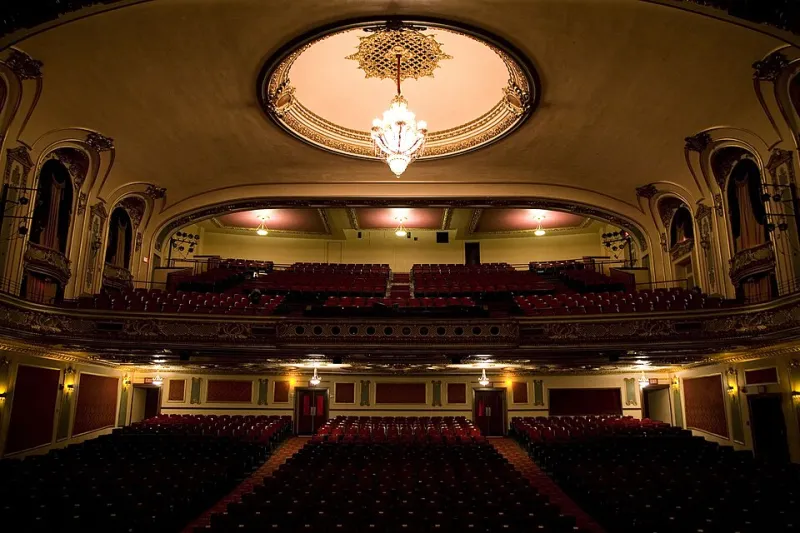
For audiences who now settle into the Fox's velvet seats and look upward at the restored ceiling, or who pause in the lobby to examine the metalwork that frames a doorway, the building offers something that no digital reproduction can replicate: the direct, physical encounter with human skill applied in the service of something larger than itself.
That is what Detroit built in 1928. That is what the restoration returned to the city. And that is what every performance at the Fox Theatre now takes place within — not merely a renovated venue, but a recovered conversation between past ambition and present possibility.